Sydney Cricket Ground Pitch Report: Complete and In-Depth Analysis for Test, ODI, and T20 Cricket

Sydney Cricket Ground Pitch Report

The Sydney Cricket Ground Pitch Report is among the most closely followed and widely searched topics in world cricket. Whether you are a fan tracking match conditions, a player preparing for competition, a coach planning tactics, or a fantasy cricket user building a winning lineup, understanding the behavior of the SCG pitch is essential.

The Sydney Cricket Ground—universally known as the SCG—is not just another stadium. It is one of the oldest, most storied cricket venues in the world, steeped in tradition and history. Over nearly two centuries, it has hosted legendary Test matches, high-pressure One Day Internationals, and modern-day T20 thrillers. What makes SCG especially fascinating is its distinct pitch behavior, which differs from many other Australian grounds and often plays a decisive role in match outcomes.

This detailed article delivers a complete, format-wise, and historically informed Sydney Cricket Ground Pitch Report, covering Test, ODI, and T20 cricket. It also includes pitch history, batting and bowling conditions, toss impact, weather influence, average scores, records, fantasy cricket insights, and strategic considerations for teams.

About the Sydney Cricket Ground (SCG)

The Sydney Cricket Ground is located in Moore Park, close to the heart of Sydney, Australia. Despite being surrounded by a major metropolitan area, the stadium offers an intimate viewing experience, with spectators close to the action from almost every seat.

Key Stadium Information

DetailInformation
Official NameSydney Cricket Ground
Commonly Known AsSCG
Former NamesGarrison Ground (1848–1877), Association Ground
Established1848
Seating CapacityApproximately 44,000
Playing Area156 m (length) × 154 m (width)
End NamesPaddington End, Randwick End
FloodlightsYes
Pitch TypeNatural Grass
CuratorTom Parker
Other Sports HostedAustralian Rules Football (Sydney Swans)

The SCG’s architecture blends tradition with modern upgrades. While the famous grassy hill no longer exists, it has been replaced by iconic stands such as the Brewongle Stand, Churchill Stand, O’Reilly Stand, Noble Stand, and Doug Walters Stand. The historic Ladies Pavilion, with its green roof, remains one of the most recognisable structures in world cricket.

Historical Significance of the SCG Pitch

Cricket has been played at this venue since 1848, making it one of the oldest continuously used cricket grounds on the planet. In its early years, the SCG pitch was known as a batsman’s paradise, producing enormous scores and legendary individual performances.

One of the most iconic moments came during the 1929–30 season, when Sir Donald Bradman scored his career-best 452 not out for New South Wales against Queensland—a record innings that still defines the SCG’s legacy.

From the 1970s onward, however, the character of the pitch gradually evolved. Changes in soil composition, preparation methods, and curator philosophy transformed SCG into a venue that increasingly assisted spin bowlers, particularly in longer formats. This shift was evident in Australia’s spin-dominated Test victories during the 1980s, including memorable performances by Bob Holland, Murray Bennett, and Allan Border.

Despite its reputation for spin, the SCG has never excluded fast bowlers or batters. Outstanding innings such as Brian Lara’s 277 and exceptional bowling spells like Fanie de Villiers’ 10/123 highlight the balanced but tactical nature of this surface.

Overview of Sydney Cricket Ground Pitch Characteristics

Unlike other Australian grounds known for pace and bounce, the Sydney Cricket Ground pitch report consistently points to a surface that rewards patience, technique, and tactical intelligence.

Core Pitch Traits

  • Generally flat and batting-friendly early
  • Slows down as matches progress
  • Offers significant assistance to spin bowlers
  • Rewards bowlers who use variations and accuracy
  • Becomes increasingly challenging in later stages of Test matches

These qualities make SCG one of the most strategically demanding venues in international cricket.

Sydney Cricket Ground Pitch Report for Test Matches

In Test cricket, the SCG pitch is often described as a five-day surface that evolves dramatically over time.

Early Match Conditions (Days 1–2)

  • Surface is firm and relatively flat
  • Consistent bounce allows batters to play confidently
  • New-ball fast bowlers may find mild swing, especially under cloud cover
  • Big partnerships are common during this phase

Middle to Late Match Conditions (Days 3–5)

  • Pitch begins to wear and crack
  • Spin bowlers come into the game with increasing turn and bounce
  • Footmarks outside the right-hander’s off stump become dangerous
  • Batting becomes progressively difficult

By the fifth day, chasing even moderate targets can be extremely challenging.

Test Match Trends at SCG

AspectObservation
Preferred Choice After TossBat first
Key Match-WinnersSpin bowlers
Ideal First Innings Score400+
Difficulty of 4th InningsVery High

Sydney Cricket Ground Pitch Report for ODIs

The Sydney Cricket Ground pitch report for ODIs suggests a well-balanced surface that supports competitive cricket.

Batting Conditions

  • True bounce during the first innings
  • Ball comes nicely onto the bat
  • Stroke-makers enjoy driving and timing

Bowling Conditions

  • Spinners and slower bowlers gain effectiveness as the pitch slows
  • Limited dew means bowlers retain control in the second innings

Average ODI Scores at SCG

InningsAverage Score
First Innings260–300
Second Innings240–280

Defending totals is often easier than at some other Australian venues due to minimal dew and the pitch’s gradual slowdown.

Sydney Cricket Ground Pitch Report for T20 Matches

T20 cricket at the SCG delivers excitement, but not without tactical nuance.

T20 Pitch Behavior

  • Generally batting-friendly
  • Quick outfield accelerates scoring
  • Boundaries are reachable but not tiny
  • Spinners and cutters are effective in middle overs

Competitive T20 Scores

Match SituationRuns
Par Score160–170
Strong Score180+
Difficult to Chase190+

Teams that balance power-hitting with disciplined bowling often succeed here.

Batting Conditions at the Sydney Cricket Ground

Batting at SCG is all about timing, patience, and adaptability.

  • Early stages favor technically sound batters
  • Long innings are rewarded in Test cricket
  • Placement matters more than brute force
  • Against spin, footwork becomes critical

Many legendary batters have built defining innings at this venue by respecting the pitch’s changing nature.

Bowling Conditions at the Sydney Cricket Ground

The Sydney Cricket Ground pitch report highlights the importance of adaptability for bowlers.

Bowling Advantages by Type

Bowler TypeEffectiveness
Fast BowlersEarly swing with new ball
Medium PacersHigh effectiveness with cutters
Spin BowlersMajor impact from Day 3 onward

Spinners, in particular, often dominate matches, especially in Tests and second innings of limited-overs games.

Toss Impact at the SCG

The toss plays a significant role at the Sydney Cricket Ground.

Toss Decisions by Format

FormatPreferred Decision
TestBat first
ODIDepends on conditions
T20Flexible, based on team strength

Captains often lean towards batting first to exploit the pitch before it deteriorates.

Weather Impact on Sydney Cricket Ground Pitch Report

Weather can subtly but decisively influence matches at SCG.

  • Sunny conditions favour batters
  • Overcast skies help swing bowlers
  • Rain adds moisture, aiding seam early but slowing the pitch later

Teams carefully monitor forecasts before finalising strategies.

Average Scores at Sydney Cricket Ground (All Formats)

FormatAverage 1st Innings Score
Test350–450
ODI260–300
T20160–190

These figures serve as benchmarks for teams and analysts alike.

Records and Iconic Performances at SCG

The SCG has hosted some of cricket’s greatest moments:

  • Don Bradman’s 452*
  • Brian Lara’s monumental double century
  • Match-winning spin spells in Ashes Tests
  • High-scoring modern T20 encounters

The venue’s history reinforces the value of understanding pitch behavior.

Fantasy Cricket Tips Based on Sydney Cricket Ground Pitch Report

Fantasy cricket users can gain a clear edge by reading the SCG pitch correctly.

Recommended Fantasy Picks

  • Top-order batters
  • Spin-bowling all-rounders
  • Accurate spinners
  • Medium pacers with variations

Avoid overloading teams with express pace bowlers unless conditions strongly favour them.

Team Strategies Based on SCG Pitch Conditions

Successful teams at SCG usually focus on:

  • Strong top-order batting
  • At least one high-quality spinner
  • Bowlers who can adapt to slow conditions
  • Athletic fielders to cover the large ground

Balanced team composition is key.

Comparison with Other Australian Cricket Grounds

GroundKey Feature
Perth StadiumPace and bounce
Brisbane (Gabba)Fast, lively surface
Melbourne (MCG)Balanced conditions
Adelaide OvalBatting-friendly
Sydney (SCG)Spin-friendly, tactical

This contrast makes SCG uniquely challenging.

Also read: Niranjan Shah Stadium Rajkot Pitch Report: Batting Paradise or Bowler’s Challenge? Full Analysis

Why the Sydney Cricket Ground Pitch Report Matters

The Sydney Cricket Ground Pitch Report is vital for:

  • Players preparing techniques
  • Coaches planning strategies
  • Analysts predicting outcomes
  • Fans understanding match dynamics

Accurate pitch knowledge enhances decision-making at every level.

Future Trends in SCG Pitch Preparation

Modern pitch management aims to maintain fairness while preserving SCG’s traditional characteristics. While technology and preparation methods evolve, spin assistance is expected to remain a defining feature of the venue.

Also read: ACA-VDCA Stadium in Visakhapatnam Pitch Report: Records, Average Score & Weather Impact

Conclusion

The Sydney Cricket Ground Pitch Report remains one of the most important resources in world cricket. With its rich history, evolving pitch behavior, and tactical complexity, the SCG offers a unique challenge across all formats.

Batters thrive early, spinners dominate late, and strategy often determines success more than raw power. Whether you are watching, playing, analysing, or selecting a fantasy team, understanding the SCG pitch provides a decisive advantage.

Few venues in world cricket combine tradition, challenge, and intrigue quite like the Sydney Cricket Ground—and its pitch continues to shape unforgettable matches generation after generation.

Niranjan Shah Stadium Rajkot Pitch Report: Batting Paradise or Bowler’s Challenge? Full Analysis

Niranjan Shah Stadium Rajkot Pitch Report

Niranjan Shah Stadium Rajkot pitch report is one of the most searched topics among cricket fans who want to understand how matches behave at this modern Indian cricket venue.

The Niranjan Shah Stadium, located in Rajkot, Gujarat, is one of the newest and most impressive cricket stadiums in India. Officially known as the Saurashtra Cricket Association Stadium, it has quickly become a favorite venue for international and domestic matches. With its world-class facilities, large seating capacity, and excellent outfield, the stadium has hosted high-scoring games as well as thrilling bowling performances.

This detailed guide explains everything about the pitch nature, batting and bowling conditions, average scores, records, weather impact, and team strategies. Whether you are a cricket fan, fantasy cricket player, or analyst, this article will help you understand the ground in simple and clear language.

Overview of Niranjan Shah Stadium Rajkot

The Niranjan Shah Stadium is located about 11 kilometers from Rajkot city and is considered one of the largest cricket stadiums in India by capacity. It was built to replace the old Khanderi Stadium and has since become the main cricket venue of Saurashtra.

The stadium is named after Niranjan Shah, a former secretary of the Board of Control for Cricket in India. Since its inauguration, it has hosted international matches across all formats including Tests, ODIs, and T20Is, along with Indian Premier League and domestic fixtures.

The ground is known for its flat surface, quick outfield, and excellent viewing angles. Because of these factors, matches played here often produce entertaining cricket with plenty of runs.

Niranjan Shah Stadium Rajkot Pitch Report

The Niranjan Shah Stadium Rajkot pitch report suggests that the surface is generally batting-friendly, especially during the first half of the match. The pitch is made of black soil, which helps the ball come nicely onto the bat and allows stroke players to play freely.

In most matches, the pitch remains hard with good bounce. This makes it ideal for aggressive batting and fast scoring. Bowlers need discipline and smart variations to succeed on this surface.

As the match progresses, the pitch may slow down slightly, bringing spinners into the game. However, it rarely breaks or turns sharply, making it a balanced wicket overall.

Nature of the Pitch Surface

The pitch at Rajkot is usually flat and firm. During the initial overs, fast bowlers can get some movement if there is moisture, but this assistance does not last long. Once the ball becomes older, batting becomes easier.

The even bounce is one of the biggest advantages for batters. Mistimed shots often still travel far due to the fast outfield. Because of this, teams prefer to bat first and put a big total on the board.

Batting Conditions

Batting at the Niranjan Shah Stadium is considered comfortable. The boundaries are moderate in size, and the ball travels quickly once it crosses the infield.

Top-order batters usually enjoy playing here, especially those who rely on timing rather than power. Big hundreds and quick half-centuries have been common at this venue.

During day matches, visibility is excellent, making stroke play easier. In night matches, dew plays an important role and further supports batting in the second innings.

Bowling Conditions

Fast bowlers need to rely on accuracy rather than pace. Short-pitched bowling is not very effective due to consistent bounce. Swing is limited unless weather conditions support it early on.

Spinners become useful in the middle overs when the pitch slows slightly. Those who bowl with flight, variation, and good line can pick wickets.

Death bowling is often challenging here, as batters target straight boundaries. Yorkers, slower balls, and wide yorkers are essential for success.

Weather Impact on Pitch Behavior

Rajkot usually experiences hot and dry weather. Temperatures during matches often remain high, especially in afternoon games.

Dry conditions help maintain pitch hardness, which supports batting. However, excessive heat can make the surface slower as the match goes on.

In evening games, dew becomes a major factor. Dew makes the ball slippery, reducing grip for spinners and making it difficult for bowlers to defend totals.

Because of this, captains winning the toss in night matches often choose to bowl first.

Average Scores at Niranjan Shah Stadium Rajkot

Understanding average scores is important to read the Niranjan Shah Stadium Rajkot pitch report accurately.

Average Scores by Format

Match FormatAverage First Innings ScoreNotes
Test Match380–420 runsBest for batting in first two days
ODI285–310 runsScores above 300 are common
T20175–190 runsHigh-scoring venue
IPL180+ runsDew helps chasing teams

Niranjan Shah Stadium Rajkot Records

The stadium has witnessed several memorable performances across formats.

The stadium has witnessed several memorable performances across formats.

Highest Team Totals

FormatHighest Team Score (Approx)
Test600+ runs
ODI350+ runs
T20220+ runs

Lowest Team Totals

FormatLowest Team Score (Approx)
TestAround 200 runs
ODIAround 180 runs
T20Below 120 runs

Low scores are rare at this venue. Most collapses occur due to poor shot selection rather than pitch difficulty.

Individual Records

Many international batters have scored centuries here. Double centuries in Test matches show how good the surface can be for patient batters.

Fast bowlers usually take wickets through bounce and movement with the new ball, while spinners succeed through consistency.

Toss Factor at Niranjan Shah Stadium

The toss plays an important role in match strategy. Based on past matches, teams prefer different approaches depending on format.

FormatPreferred Decision After TossReason
TestBat FirstFresh pitch supports long innings
ODIBowl FirstDew helps chasing
T20Bowl FirstHigh success rate while chasing

Pitch Report for Different Formats

Test Match Pitch Report

The Test pitch in Rajkot is ideal for traditional cricket. It supports long batting innings and rewards patience. Spinners play a key role from day four onward.

Fast bowlers need to work hard for wickets, especially after the new ball loses shine.

ODI Pitch Report

The ODI surface is flat with consistent bounce. Teams focus on building strong partnerships and accelerating after the 30th over.

Bowling sides rely heavily on middle-over wickets to restrict scoring.

T20 Pitch Report

T20 pitches here are prepared to support entertainment. Expect boundaries, sixes, and aggressive powerplay batting.

Bowlers who vary pace and length are more successful than those who rely only on speed.

Fantasy Cricket Tips Based on Pitch

The Niranjan Shah Stadium Rajkot pitch report is extremely useful for fantasy cricket players.

CategoryBest Picks
BattersTop-order batters
BowlersDeath-over pacers, smart spinners
All-roundersBatting all-rounders
AvoidDefensive middle-order batters

Team Strategy on This Pitch

Teams batting first aim for above-par totals. In T20s, a score of 190 or more puts pressure on chasing teams.

While chasing, teams usually start aggressively, knowing the pitch remains good under lights.

Bowling sides focus on early wickets, as defending totals becomes difficult once batters settle.

Using spinners smartly in the middle overs is often the key difference.

Comparison with Other Indian Grounds

Compared to Chennai or Delhi, Rajkot offers less spin and more batting comfort.

Unlike Mumbai, the bounce is more consistent and predictable.

Compared to Ahmedabad, Rajkot has slightly shorter boundaries and a faster outfield.

Overall, it ranks among the best batting surfaces in India.

Also read: Stadium in Visakhapatnam Pitch Report: Complete Guide for Matches, Records, and Playing Conditions

Crowd and Atmosphere Influence

The Rajkot crowd is passionate and supportive. Large crowds create pressure, especially during IPL and international matches.

The energy often lifts home players and motivates aggressive cricket.

Evening matches with full attendance create an exciting environment that favors attacking play.

Future of Matches at Niranjan Shah Stadium

With its modern infrastructure and excellent pitch quality, the stadium is expected to host more international matches in the future.

Its ability to produce results while still favoring batters makes it suitable for all formats.

The ground is also becoming popular for major tournaments and knockout matches.

Also read: Kotambi Stadium Vadodara Pitch Report: Complete Analysis with Stats, Scores, and Match Conditions

Conclusion: on Niranjan Shah Stadium Rajkot Pitch Report

The Niranjan Shah Stadium Rajkot pitch report clearly shows that this venue is one of the most batting-friendly grounds in India. The pitch offers true bounce, minimal uneven movement, and excellent scoring opportunities.

While bowlers do get some help with the new ball and during middle overs, batting remains dominant throughout most matches. Dew plays a big role in night games, often influencing toss decisions and match results.

For fans, it promises entertaining cricket. For players, it rewards skill and timing. And for fantasy users and analysts, understanding this pitch can make a big difference.

Overall, Niranjan Shah Stadium in Rajkot stands as a modern cricket venue where high scores, big performances, and memorable moments are almost guaranteed.

ACA-VDCA Stadium in Visakhapatnam Pitch Report: Records, Average Score & Weather Impact

Stadium in Visakhapatnam Pitch Report

Stadium in visakhapatnam pitch report is one of the most searched topics among cricket fans who want to understand how matches behave at this popular Indian venue. Known officially as the Dr. Y.S. Rajasekhara Reddy ACA–VDCA Cricket Stadium, this ground has hosted several international and domestic matches and is famous for its balanced playing surface and scenic coastal setting.

Located close to the Bay of Bengal, the stadium offers unique pitch behavior influenced by sea breeze, humidity, and red-soil conditions. Whether it is a Test match, ODI, T20I, or IPL game, the pitch in Visakhapatnam often plays an important role in deciding match outcomes.

This detailed guide explains pitch nature, batting and bowling conditions, average scores, weather impact, records, and team strategies in very simple and clear English.

Overview of ACA–VDCA Cricket Stadium, Visakhapatnam

The ACA–VDCA Cricket Stadium is one of India’s most modern cricket grounds. It is managed by the Andhra Cricket Association and has become a regular venue for international cricket.

The stadium is located in Yendada, on the outskirts of Visakhapatnam city. Its peaceful surroundings, good drainage system, and high-quality pitch preparation make it suitable for matches in all seasons.

Capacity is around 27,000 spectators, and the stadium is known for excellent visibility from all stands.

Stadium in Visakhapatnam Pitch Report and Surface Nature

The stadium in visakhapatnam pitch report generally describes the surface as balanced, offering something for both batters and bowlers depending on the match format.

The pitch is prepared using red soil, which is different from the black-soil pitches seen in many other Indian grounds. Red-soil pitches usually provide better bounce and pace, especially in the early stages of a match.

In the first few overs, fast bowlers get movement off the surface. As the match progresses, the pitch settles and becomes easier for batting.

Spin bowlers come into play later, particularly in longer formats.

Pitch Behavior in Test Matches

In Test cricket, the Visakhapatnam pitch is known for changing its nature over five days.

Match DaysPitch BehaviorAdvantage
Day 1Hard surface, good bounceFast bowlers early
Day 2Stable and flatBatters
Day 3Drying surfaceSpinners start helping
Day 4–5Rough patches, slow bounceSpinners dominate

Overall, the Test pitch favors teams with quality spinners and patient batters.

Pitch Behavior in ODI Matches

The stadium in visakhapatnam pitch report for ODIs shows that the surface is usually batting-friendly.

PhasePitch Nature
PowerplaySwing and seam movement
Middle OversFlat surface, easy batting
Death OversGood bounce, high scoring

Average first-innings ODI scores here range between 270 and 300.

Pitch Behavior in T20 and IPL Matches

In T20 cricket, the Visakhapatnam pitch is known for high-scoring games.

AspectDetails
BounceTrue and consistent
Boundary SizeMedium to short
Dew FactorHigh in night matches
Bowling TypeSlower balls effective

Average T20 first-innings score is around 165 to 185.

Batting Conditions at Visakhapatnam Stadium

Batters generally enjoy playing at this venue due to the consistent bounce.

Timing the ball is easier compared to slower Indian pitches. Drives and pull shots are particularly effective.

However, patience is required early in the innings, as careless shots against the moving ball can result in quick wickets.

Once set, batters can score big hundreds here.

Bowling Conditions at Visakhapatnam Stadium

Bowling TypeSupport from PitchBest Time to Bowl
Fast BowlersGood bounce, early swingFirst 10 overs
Finger SpinnersGrip and bounceMiddle to late overs
Wrist SpinnersLimited turnDry surfaces

In Test matches, spinners can be match-winners in the later days.

Average Scores at ACA–VDCA Stadium

Understanding average scores helps predict match trends at this venue.

Match FormatAverage First Innings ScoreCompetitive Score
Test Match380–420450+
ODI270–300310+
T20 / IPL165–185190+

These numbers can vary based on weather, pitch freshness, and match timing.

Toss Factor at Visakhapatnam Stadium

Match FormatToss PreferenceReason
TestBat FirstPitch deteriorates
ODIBowl FirstDew advantage
T20Bowl FirstEasier chasing

Captains carefully analyze humidity, weather forecast, and pitch color before deciding.

Weather Impact on Pitch Behavior

Visakhapatnam has a coastal climate with high humidity.

Humidity helps swing bowlers, especially under lights.

Rain is occasional but the stadium has an excellent drainage system, allowing quick resumption of play.

Day matches are usually hot, while evening games see dew affecting bowlers.

Boundary Dimensions and Ground Size

The boundaries at the ACA–VDCA Stadium are medium-sized.

Straight boundaries are slightly longer, while square boundaries are shorter.

This encourages batters to play cross-batted shots in white-ball cricket.

The fast outfield ensures good value for timing rather than pure power.

Records at Visakhapatnam Cricket Stadium

The stadium has witnessed several memorable performances.

Many international centuries have been scored here across formats.

Fast bowlers have recorded five-wicket hauls, while spinners have dominated Test matches.

The venue is known for producing competitive matches rather than one-sided contests.

IPL Matches at Visakhapatnam

Visakhapatnam has served as a temporary home venue for IPL teams.

IPL matches here usually see high-scoring encounters with exciting finishes.

The pitch favors aggressive batting, making it ideal for T20 entertainment.

Teams with strong all-rounders often perform well on this surface.

Domestic Cricket at the Stadium

The ground regularly hosts Ranji Trophy and domestic white-ball matches.

Domestic players appreciate the true bounce, which helps develop fast bowling talent.

Many young Indian cricketers have made strong performances here before stepping into international cricket.

Read also: Kotambi Stadium Vadodara Pitch Report: Complete Analysis with Stats, Scores, and Match Conditions

Team Strategy Based on Stadium in Visakhapatnam Pitch Report

Teams usually plan their playing XI carefully based on the pitch report.

A balanced combination of three fast bowlers and one spinner is common in ODIs and T20s.

In Tests, teams often play two spinners due to fourth-innings assistance.

Batting depth is important, as partnerships play a key role at this venue.

Strengths of the Visakhapatnam Pitch

The pitch offers fair contest between bat and ball.

It supports all formats of the game.

Good bounce reduces the risk of unpredictable behavior.

Weather and dew add strategic complexity.

Challenges of Playing at This Venue

High humidity can be physically demanding.

Dew makes bowling difficult in night matches.

Spinners must be patient and consistent.

Batters need good shot selection early in the innings.

Read also: Guwahati, Assam,Barsapara Stadium Pitch Report: Complete Surface Analysis, Conditions, and Match Guide

Stadium in Visakhapatnam Pitch Report Summary

Stadium in visakhapatnam pitch report clearly shows that the ACA–VDCA Cricket Stadium is one of the most balanced cricket venues in India. The red-soil surface offers bounce and pace early, becomes batting-friendly in the middle, and assists spinners later in the game.

Across formats, the pitch produces competitive scores and exciting cricket. Teams that adapt quickly to conditions usually succeed here.

For fans, analysts, and fantasy cricket players, understanding the pitch behavior at Visakhapatnam provides valuable insight into match predictions and team strategies.

With its beautiful location, modern facilities, and reliable pitch conditions, the Visakhapatnam Cricket Stadium continues to be an important destination on India’s cricketing map.

Kotambi Stadium Vadodara Pitch Report: Complete Analysis with Stats, Scores, and Match Conditions

Kotambi Stadium Vadodara Pitch Report

Kotambi Stadium Vadodara pitch report is very important for cricket fans, fantasy players, and teams who want to understand how matches behave at this venue. Kotambi Stadium in Vadodara, Gujarat, is becoming popular for domestic and league matches due to its modern facilities and balanced pitch conditions.

This article provides a fully detailed and easy-to-understand pitch report with proper tables wherever needed. The language is simple, natural, and written in a smooth human tone for better readability.

About Kotambi Stadium Vadodara

Kotambi Stadium is located in Vadodara city of Gujarat. It has been developed to support domestic cricket and training matches. The stadium is maintained by the Baroda Cricket Association and features good drainage, practice nets, and spectator seating.

Vadodara has a strong cricket culture, and this stadium is playing an important role in promoting young talent from the region.

Kotambi Stadium Vadodara Pitch Report Overview

The Kotambi Stadium Vadodara pitch report indicates a balanced pitch that supports both batting and bowling. The surface is not extremely flat, but it also does not heavily favor bowlers.

The pitch behavior changes with match format and weather conditions. Early overs generally help fast bowlers, while spinners dominate the middle and later phases of the game.

Pitch Nature Summary

FactorBehavior
Pitch typeBlack soil mixed with red soil
BounceMedium and consistent
PaceModerate
Spin supportGood in middle overs
Batting difficultyMedium
Dew impactHigh in night matches

Batting Conditions at Kotambi Stadium

Batting at Kotambi Stadium requires proper technique, especially in the early overs. The new ball moves slightly due to surface moisture and grass.

Once batsmen settle at the crease, shot-making becomes easier. Timing works better than pure power on this pitch.

Batting Characteristics

AspectDetails
Powerplay oversSlightly difficult
Middle oversBest phase for batting
Death oversSlower balls effective
Boundary scoringDepends on timing
Big totalsPossible with partnerships

Top-order batsmen usually perform better than lower-order hitters.

Bowling Conditions at Kotambi Stadium

According to the Kotambi Stadium Vadodara pitch report, bowlers remain in the game throughout the match.

Fast Bowlers Performance

Fast bowlers enjoy early swing and seam movement.

PhaseSupport
New ballGood swing and seam
Middle oversLimited help
Death oversSlower balls and cutters effective

Bowlers with good line and length often succeed here.

Spin Bowlers Performance

Spin plays a very important role at Kotambi Stadium.

Type of spinnerEffectiveness
Off-spinnersVery effective
Left-arm spinUseful in middle overs
Leg-spinnersModerate success
Part-time spinHelpful on dry days

As the pitch dries, grip and turn increase.

Kotambi Stadium Vadodara Pitch Report for T20 Matches

In T20 cricket, Kotambi Stadium usually produces moderate scoring games.

T20 Pitch Behavior

AspectDetails
Average 1st innings score150–170
High score potential190+
Lowest defendable score145
Best strategyBat deep
Toss preferenceBowl first

Power-hitting is possible but not easy throughout the innings.

Kotambi Stadium Vadodara Pitch Report for ODI Matches

The pitch offers stability in one-day matches. Batsmen can score freely after surviving the first few overs.

ODI Match Conditions

CategoryData
Average first innings score260–290
Par score280
Best time to batOvers 11–40
Spin impactHigh
Chasing successModerate

Teams with strong middle-order batting usually perform well.

Kotambi Stadium Vadodara Pitch Report for Test and Domestic Matches

In long-format matches, the pitch changes significantly over time.

Day-wise Pitch Behavior

Match DayPitch Nature
Day 1Batting-friendly
Day 2Balanced
Day 3Spin starts
Day 4Turn increases
Day 5Difficult batting

Fourth-innings run chases are challenging due to uneven bounce and turn.

Average Scores at Kotambi Stadium Vadodara

Based on available domestic data, the scoring pattern is as follows:

FormatAverage 1st Innings Score
T20155–170
ODI260–290
Four-day match320–380

Scores depend heavily on pitch preparation and weather.

Toss Analysis at Kotambi Stadium

The toss plays a key role, especially in limited-overs formats.

Toss Decision Table

FormatPreferred Choice
T20Bowl first
ODIBowl first (night)
TestBat first

Dew becomes a major factor during evening matches.

Weather Impact on Pitch

Vadodara has a hot and dry climate for most of the year.

Weather Influence

Weather ConditionPitch Effect
High temperatureSurface dries quickly
Dry weatherSpin-friendly
Cloud coverSwing for pacers
DewFavors chasing team
MonsoonMoist pitch

Day-night matches are highly influenced by dew.

Ground Dimensions and Boundaries

Kotambi Stadium has fairly balanced boundaries.

Boundary AreaApproximate Size
Square boundaries65–70 meters
Straight boundaries75–78 meters
Short sideAround 63 meters

This layout rewards timing more than raw power.

Outfield and Fielding Conditions

The outfield is well-maintained and quick.

FeatureQuality
GrassEven
SpeedFast
DrainageGood
Fielding difficultyMedium

Quick singles and boundaries are common once the ball beats the infield.

Ideal Team Combination

Based on the Kotambi Stadium Vadodara pitch report, teams prefer balance.

Recommended XI Combination

RoleCount
Specialist batsmen4–5
Fast bowlers2–3
Spinners2
All-rounders2
Wicketkeeper1

Spin bowling all-rounders add extra value.

Fantasy Cricket Tips for Kotambi Stadium

Fantasy players should focus on consistency rather than aggressive hitters.

Best Fantasy Picks

CategoryRecommendation
BatsmenTop-order players
BowlersSpinners and new-ball pacers
All-roundersSpin all-rounders
Captain choiceReliable batsman
Vice-captainBowling all-rounder

Avoid selecting too many tail-end batters.

Strengths of Kotambi Stadium Pitch

StrengthBenefit
Balanced surfaceFair competition
Spin supportExciting middle overs
Consistent bounceGood stroke play
Good outfieldBetter scoring flow

Weaknesses of the Pitch

LimitationImpact
Slow natureLow run rate early
HeatPlayer fatigue
Limited bounce lateFast bowlers struggle

Despite this, the pitch remains ideal for domestic cricket.

Comparison with Other Gujarat Stadiums

StadiumPitch Nature
Narendra Modi StadiumBatting-friendly
Kotambi StadiumBalanced and spin-friendly
Baroda Cricket Association GroundSlower than Kotambi

Kotambi Stadium provides more consistent bounce than older grounds.

Future of Kotambi Stadium Vadodara

The stadium is expected to host more domestic tournaments, women’s international matches, and league games in the coming years. With improved pitch preparation, it may soon become one of Gujarat’s major cricket venues.

Also read: Guwahati, Assam,Barsapara Stadium Pitch Report: Complete Surface Analysis, Conditions, and Match Guide

Conclusion: on Kotambi Stadium Vadodara Pitch Report

The Kotambi Stadium Vadodara pitch report confirms that this venue offers a fair and competitive surface for all formats of cricket. It supports fast bowlers early, helps spinners in the middle, and allows batsmen to score once they settle.

The pitch encourages technical batting, smart bowling, and proper match planning. Whether it is a T20, ODI, or domestic red-ball match, Kotambi Stadium in Vadodara promises exciting cricket with a true balance between bat and ball.

Guwahati, Assam,Barsapara Stadium Pitch Report: Complete Surface Analysis, Conditions, and Match Guide

Barsapara Stadium Pitch Report

Barsapara Stadium pitch report is very important for cricket fans, fantasy players, and team analysts who want to understand how matches behave at this venue in Guwahati. Officially known as Dr. Bhupen Hazarika Cricket Stadium, it is one of India’s newest international cricket grounds and has quickly gained popularity.

This article provides a fully detailed and simple explanation of pitch behavior, batting and bowling support, weather impact, average scores, toss strategy, and format-wise performance. Tables are added wherever needed to make information clear and easy to understand.

Introduction to Barsapara Stadium

Barsapara Stadium is located in Guwahati, Assam, and is the largest cricket stadium in Northeast India. It was inaugurated in 2017 and has since hosted several international and domestic matches.

The stadium has a seating capacity of nearly 40,000 spectators and features modern drainage, floodlights, and high-quality turf. Because of its scenic surroundings and enthusiastic crowd, it has become a favorite venue for players and fans.

Barsapara Stadium Pitch Report Overview

The Barsapara Stadium pitch report suggests that the surface is generally balanced, with slight help for batters in white-ball cricket. The pitch is prepared using black soil mixed with grass, which allows good bounce and carry.

Early in the match, fast bowlers can get swing, while later the pitch becomes slower and helps spinners and change-of-pace bowlers.

Type of Pitch at Barsapara Stadium

FeatureDetails
Soil typeBlack soil
Grass coverLight to moderate
BounceEven
Pace supportEarly overs
Spin supportMiddle to late overs
Overall natureBalanced

The pitch is not extreme in nature, making matches competitive and enjoyable.

Batting Conditions at Barsapara Stadium

According to the Barsapara Stadium pitch report, batting is comfortable once players settle at the crease. The ball comes nicely onto the bat, especially under lights.

Key batting highlights include:

  • True bounce helps stroke play
  • Fast outfield supports boundary hitting
  • Short square boundaries increase scoring chances
  • Timing is easier in the first innings

However, as the pitch slows down, mistimed shots can bring fielders into play.

Bowling Conditions at Barsapara Stadium

Fast Bowling Support

Fast bowlers benefit mainly in the powerplay overs. Swing and seam movement depend heavily on humidity and cloud cover.

Bowling PhaseAssistance
New ballSwing and seam
Middle oversLimited pace support
Death oversCutters and slower balls

Bowlers who rely on variation rather than speed are usually successful here.

Spin Bowling Support

Spin bowling comes into action when the pitch dries out.

Spin TypeEffectiveness
Finger spinnersVery effective
Wrist spinnersModerate
Part-time spinnersUseful for control

The pitch does not offer sharp turn, but accuracy brings rewards.

Barsapara Stadium Pitch Report for T20 Matches

The Barsapara Stadium pitch report for T20 cricket shows a batting-friendly surface with high-scoring possibilities.

T20 Match FactorDetails
Average 1st innings score170–180
Highest team totals200+ possible
Best strategyBowl first
Dew impactHigh
Chasing advantageStrong

Powerplay overs play a major role in deciding the match result.

Barsapara Stadium Pitch Report for ODI Matches

ODI matches at Barsapara Stadium provide balanced contests.

ODI FactorDetails
Average 1st innings score270–290
Pitch behaviorSlows gradually
Batting difficultyModerate
Best phase to batOvers 10–40
Best phase to bowlFirst 10 overs

Teams with strong middle-order batting and all-rounders perform better in ODIs.

Barsapara Stadium Pitch Report for Test Matches

Though Test matches are rare at this venue, the pitch is suitable for five-day cricket.

DayPitch Behavior
Day 1Good for batting
Day 2Balanced
Day 3Slow turn begins
Day 4–5Spin-friendly

The surface encourages proper Test match skills rather than extreme conditions.

Weather Conditions in Guwahati

Weather strongly influences the Barsapara Stadium pitch report.

Weather FactorImpact
HumidityHelps swing
RainAdds moisture
TemperatureModerate
WindAffects aerial shots

Guwahati often experiences humid evenings, which benefit fast bowlers early on.

Dew Factor at Barsapara Stadium

Dew is one of the most decisive elements in night matches.

Dew EffectResult
Wet outfieldFaster boundaries
Slippery ballBowling difficulty
Spin gripReduced
BattingEasier while chasing

Because of this, captains usually choose to bowl first after winning the toss.

Boundary Dimensions and Ground Size

AreaApproximate Size
Straight boundary75–78 meters
Square boundary63–67 meters
Behind wicket60–65 meters
Outfield speedFast

Shorter square boundaries encourage big hitting, especially in T20 matches.

Toss Strategy at Barsapara Stadium

The toss has a strong influence on match outcomes.

Match TypePreferred Decision
T20Bowl first
ODI day-nightBowl first
ODI dayBat first possible
TestBat first

Dew conditions make chasing a safer option in limited-overs matches.

Average Scores at Barsapara Stadium

FormatAverage 1st Innings Score
T20170–180
ODI270–290
Domestic T20160–170
Women’s T20I140–155

Scores can vary depending on pitch freshness and weather.

Pitch Behavior by Match Phase

PhasePitch Nature
First 6 oversSwing and bounce
Overs 7–15Best for batting
Overs 16–20Slower surface
Second inningsDew-dependent

Understanding these phases helps teams plan better strategies.

Team Combination Ideal for This Pitch

Based on the Barsapara Stadium pitch report, teams prefer the following balance:

RoleIdeal Number
Fast bowlers2–3
Spinners1–2
All-rounders2
Specialist batters5–6

Teams with bowling depth generally succeed here.

Fantasy Cricket Tips Based on Pitch

CategoryBest Choice
BattersTop order
BowlersNew-ball pacers
All-roundersPace all-rounders
Captain pickOpening batter
Vice-captainBowling all-rounder

Avoid selecting too many spinners unless the pitch looks dry.

Strengths of Barsapara Stadium Pitch

  • Good batting surface
  • Even bounce
  • Fair contest between bat and ball
  • High-scoring matches possible
  • Ideal for white-ball cricket

The pitch rarely produces dull or one-sided games.

Weaknesses of the Pitch

  • Becomes slow late in the innings
  • Heavy dew affects bowlers
  • Limited help for wrist spinners
  • Rain interruptions during monsoon

Despite this, the pitch remains reliable and competitive.

Also read: Narendra Modi Stadium Pitch Report-Comprehensive Analysis of Ahmedabad’s Cricket Surface

Comparison With Other Indian Grounds

StadiumComparison
ChennaiMore spin-friendly
MumbaiMore batting-friendly
LucknowSlower than Barsapara
PuneSimilar conditions
DelhiLess bounce than Barsapara

Barsapara offers one of the most balanced pitches in India.

Importance of Barsapara Stadium in Indian Cricket

Barsapara Stadium has played a key role in bringing international cricket to Northeast India. It has helped grow cricket popularity in Assam and nearby states.

With improving pitch quality and strong crowd support, the venue is expected to host more IPL and ICC matches in the future.

Also read: Shaheed Veer Narayan Singh International Stadium Raipur: Pitch Report, Weather, Records, and Complete Overview-Raipur stadium pitch report weather

Conclusion: on Barsapara Stadium Pitch Report

The Barsapara Stadium pitch report clearly shows that this ground offers balanced and exciting cricket. Batters enjoy good bounce and fast outfield, while bowlers succeed through discipline, swing, and smart variations.

Dew, weather, and pitch slowdown play major roles in match results. Teams that adapt quickly and choose the right strategy usually dominate.

Overall, Barsapara Stadium is a modern Indian cricket venue that delivers competitive scores, thrilling finishes, and high-quality cricket across all formats.

Narendra Modi Stadium Pitch Report-Comprehensive Analysis of Ahmedabad’s Cricket Surface

Narendra Modi Stadium Pitch Report

The Narendra Modi Stadium Pitch Report has emerged as one of the most scrutinized and debated topics in Indian cricket. Located in Ahmedabad, Gujarat, this iconic stadium is not only the largest cricket venue in the world but also one of the most versatile in terms of pitch conditions. With a staggering seating capacity of 132,000, the stadium has witnessed countless memorable cricketing moments and continues to be a crucial venue for both international matches and the Indian Premier League (IPL). Beyond its sheer size and modern facilities, the Narendra Modi Stadium has earned a reputation for its pitch diversity, which can favor batsmen, pacers, or spinners depending on preparation and weather conditions.

This comprehensive Narendra Modi Stadium Pitch Report delves into the ground’s characteristics, soil types, historical performances, and strategic insights for teams planning to play here. Whether it’s a Test, ODI, T20, or IPL fixture, understanding the pitch behavior is critical for captains and players alike.

Stadium Overview

The Narendra Modi Stadium, formerly known as Motera Stadium, was renovated and reopened in 2020. It has since become a global cricketing landmark due to its size, facilities, and pitch versatility. Here’s a detailed overview:

AttributeDetails
LocationAhmedabad, Gujarat, India
Capacity1,32,000 (largest in the world)
EstablishedRenovated and reopened in 2020
Primary UsesTest matches, One Day Internationals (ODIs), T20Is, IPL matches
OutfieldFast, supporting quick scoring
Boundary SizeLarge boundaries, but quick outfield favors runs
Pitch TypesRed soil and black soil pitches prepared according to format

The stadium’s outfield is known for its speed, allowing well-timed shots to race to the boundary. Large boundaries combined with a rapid outfield create exciting scoring opportunities, especially in limited-overs cricket. The pitch type is adjusted depending on the match format, offering a balanced contest between bat and ball.

Pitch Behavior Across Formats

Understanding how the pitch behaves in different match formats is critical for teams. The Narendra Modi Stadium Pitch Report highlights how conditions change from the early phase to the latter stage of matches:

FormatEarly PhaseMid-GameLater Stage
Test MatchesBounce and seam for pacers when grass or moisture is presentFlattens, favoring batsmen on Day 1 and Day 2Cracks appear, spinners dominate from Day 3 onwards
ODIsBatting-friendly, especially in the first innings; good bounce for stroke playSpinners play a crucial role in the middle oversDew in the second innings aids chasing teams
T20 Matches/IPLFlat pitch with consistent bounce; ideal for stroke makersSpinners may gain grip in middle oversHigh scores common in death overs; dew assists batters

Key Insights:

  • In Test matches, the early overs are often dominated by pacers exploiting the grass and moisture. As the pitch wears, spinners take over, making the latter part of the game challenging for batsmen.
  • ODIs at this venue generally start in a batting-friendly manner, but spinners become decisive during the middle overs. Dew plays a significant role in aiding teams chasing totals in the second innings.
  • T20 and IPL matches witness high-scoring contests due to flat tracks and fast outfields. Variations and spinners are crucial in middle and death overs to control the game.

Soil Types and Their Impact

The Narendra Modi Stadium features two primary soil types for pitch preparation: red soil and black soil. Each has unique characteristics that significantly influence match outcomes.

Soil TypeCharacteristicsImpact on Match
Red SoilProvides more bounce and pacePacers and spinners benefit early; cracks create spin-friendly conditions
Black SoilRetains moisture longer; slower surfaceSpin-friendly; favors batsmen who rotate the strike efficiently

Analysis:

  • Red soil pitches are often used for white-ball games, including ODIs and T20s, due to their ability to support high-scoring matches with consistent bounce.
  • Black soil tracks are generally preferred for Tests as they retain moisture, slow the ball, and assist spinners once cracks appear on the surface.

Selecting the right soil is critical for curators to influence match dynamics. For instance, an IPL match on red soil often leads to explosive batting, whereas a Test match on black soil can favor bowlers, especially spinners.

Factors Influencing Pitch Behavior

Several external factors influence pitch performance at the Narendra Modi Stadium. Understanding these helps teams strategize effectively.

  1. Weather Conditions
    • Dry and Hot Weather: Accelerates cracking of the surface, making it conducive for spinners in later stages.
    • Overcast Conditions: Aid seamers with swing and bounce during early overs.
  2. Dew
    • Evening matches often experience heavy dew, making it difficult for bowlers to grip the ball, favoring batting teams, especially in limited-overs cricket.
  3. Pitch Preparation
    • Curators modify grass cover and rolling intensity based on match format. For Tests, more grass may be retained to aid seamers initially, while flat, dry pitches are preferred for T20s.
  4. Ground Dimensions
    • Large boundaries combined with a fast outfield enable aggressive batting while maintaining a fair contest for bowlers with variations and spin.

Historical Performance Trends

The Narendra Modi Stadium Pitch Report also relies heavily on historical data to predict trends. Examining past matches provides insights into scoring patterns and results.

FormatMatches HostedBatting First WinsChasing WinsDraw/No Result
Tests15+Teams batting first often dominateRarely successful chasesDraws common if pitch remains flat
ODIs25+Balanced outcomesSlight edge for teams chasing due to dewFew
T20Is/IPL40+High scores common; 170+ parChasing favored in IPL–

Observations:

  • Test matches show a clear advantage for teams batting first. Spinners often control the latter days of a Test, making chasing difficult.
  • ODIs feature competitive totals, but teams chasing benefit from dew in the second innings.
  • In T20s and IPL, 200+ scores are now common, highlighting the batting-friendly nature of the surface.

Notable Recent Matches

  1. IPL 2023 & 2024:
    Multiple games produced 200+ totals, underscoring the pitch’s flat nature and suitability for power-hitters.
  2. Test Matches Against England (2021):
    Pitches were prepared to favor spinners, resulting in slow scoring and low overall totals. This demonstrated the versatility of the stadium, as curators could engineer conditions to suit different strategies.
  3. World Cup 2023:
    The stadium hosted both high-scoring batting-friendly games and balanced contests, providing opportunities for both batsmen and bowlers to influence results.

Also read: Shaheed Veer Narayan Singh International Stadium Raipur: Pitch Report, Weather, Records, and Complete Overview-Raipur stadium pitch report weather

Strategies for Teams

Batting Teams

  • Utilize powerplay overs efficiently in white-ball formats.
  • Establish partnerships early in Tests before cracks appear on black soil pitches.
  • Rotate strike effectively, especially on spin-friendly tracks.
  • Adapt to dew conditions during evening matches to maximize scoring opportunities.

Bowling Teams

  • Pacers should exploit swing and bounce early, particularly with the new ball.
  • Spinners must be introduced strategically in the middle overs to control the game.
  • Variations such as slower balls, yorkers, and off-cutters are essential during T20 death overs.
  • Understanding the soil type helps determine bowling line and length for maximum impact.

Narendra Modi Stadium Pitch Report – Summary Table

AspectBattingBowling
TestsFavors early batsmen; challenging laterSpinners dominate from Day 3
ODIsEasy scoring; dew aids in second inningsPacers early; spinners middle overs
T20s/IPLHigh scoring, flat; dew assists chasingBowlers rely on variations & spin

Also read: Nagpur Vidarbha Cricket Stadium Pitch Report: India vs New Zealand 1st T20 Preview, Weather, and Probable Playing XI

Conclusion

The Narendra Modi Stadium Pitch Report provides a clear understanding of why this venue is considered one of India’s most challenging and versatile cricket grounds. From red soil pitches that favor pacers and high-scoring matches to black soil tracks that empower spinners, the stadium presents a multi-dimensional challenge for players.

  • In Tests, spinners usually dictate match outcomes as the surface deteriorates.
  • In ODIs and T20s, batting dominates early, with dew and outfield speed providing strategic advantages.
  • Captains must factor in toss, weather, and soil type to devise effective game plans.

With its world-class facilities, massive seating capacity, and dynamic pitch behavior, the Narendra Modi Stadium is set to continue hosting some of cricket’s most memorable and strategic contests. Teams that understand and adapt to these conditions can gain a significant edge, making this stadium a true battleground for both batsmen and bowlers.

Shaheed Veer Narayan Singh International Stadium Raipur: Pitch Report, Weather, Records, and Complete Overview-Raipur stadium pitch report weather

Raipur stadium pitch report weather

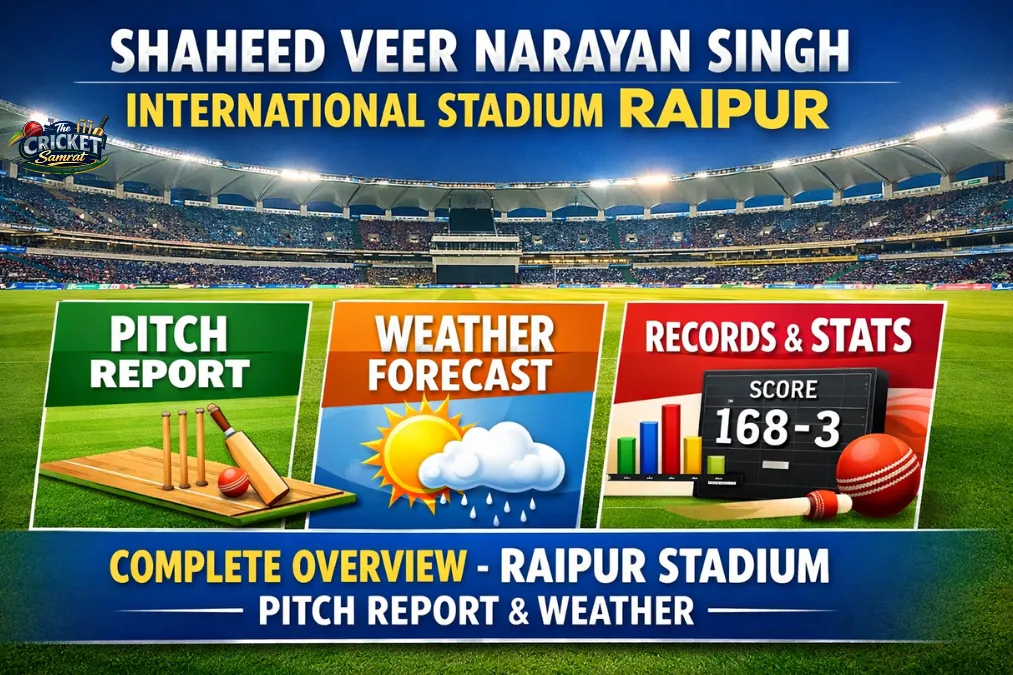
The Shaheed Veer Narayan Singh International Stadium in Raipur, Chhattisgarh, has emerged as one of India’s most modern cricket venues, combining world-class infrastructure with competitive playing conditions. Known for hosting limited international cricket, the stadium has made a mark in the T20I and ODI formats, offering fans high-intensity matches and thrilling finishes.

In this comprehensive guide, we analyze the Raipur stadium pitch report weather, examine historical records, provide boundary and ground dimensions, and break down match trends to give a complete picture for players, analysts, and cricket enthusiasts.

Overview of Shaheed Veer Narayan Singh International Stadium

Located in Naya Raipur, the stadium is a flagship sporting venue in central India. Designed with modern architecture and a bowl-shaped design, it accommodates 65,000 spectators, making it one of the largest cricket grounds in the region. Its seating arrangement, floodlight facilities, and media provisions have helped it gain recognition during IPL matches and international fixtures.

ParameterDetails
Full NameShaheed Veer Narayan Singh International Stadium
Also Known AsChhattisgarh International Cricket Stadium
LocationNaya Raipur, Chhattisgarh, India
Seating Capacity65,000 spectators
Opened Year2008
Owner / OperatorChhattisgarh State Cricket Sangh
EndsPavilion End, City End
FloodlightsYes
Home TeamChhattisgarh cricket team

The stadium is accessible via the Raipur-Bilaspur Expressway and is roughly 20 kilometers from Raipur’s city center. The choice of location ensures easy connectivity, though most spectators travel by private vehicles or chartered buses organized by cricket associations.

Ground Dimensions and Boundary Analysis

The ground’s dimensions strike a balance between batsman-friendly boundaries and fair challenge for bowlers. The outfield is maintained to allow smooth ball movement, particularly during dry months, while the stadium’s design ensures clear sightlines for spectators.

Boundary TypeDistance (meters)Notes
Square Boundaries60-65Favors aggressive batsmen for pulls, cuts, and lofted shots
Straight Boundaries70-75Requires timing and power; fewer sixes down the ground
Cover & Point Areas58-62Shortest boundaries; high six count from right-handed batsmen

The cover and point regions see the most sixes due to shorter hitting distance, while straight boundaries demand precision and strength. This layout influences batting strategies, favoring players who can exploit square-of-the-wicket shots.

Raipur Stadium Pitch Report: Batting or Bowling Friendly?

The Raipur stadium pitch report weather plays a crucial role in determining match outcomes. The pitch generally favors batsmen in limited-overs cricket, but early assistance for fast bowlers ensures competitive contests.

New Ball Behavior: The initial 5-10 overs offer seamers some movement due to grass coverage. Fast bowlers can exploit bounce and swing, but this effect diminishes quickly.

Middle Overs: The pitch flattens as the ball ages, making shot execution easier for batsmen. Run-scoring becomes straightforward, especially in ODIs and T20Is.

Role of Spinners: Spinners receive grip in the middle overs, but the pitch rarely provides sharp turn. Accuracy and variation remain key, rather than natural spin.

Dew Factor: Night matches experience heavy dew, making gripping the ball challenging. This typically favors chasing teams as bowlers struggle with control.

Overall Scoring Pattern: The pitch produces competitive totals in limited-overs cricket:

  • T20Is: 160-180 runs
  • ODIs: 250-300 runs

The combination of consistent bounce, dew assistance, and batting-friendly conditions makes Raipur a favorable venue for chasing teams.

T20I Records at Shaheed Veer Narayan Singh International Stadium

The stadium has hosted a limited number of T20Is, but the available data reveals early trends favoring batting first or chasing, depending on conditions.

Stat CategoryValue
Matches Played1
Batting First Wins1
Bowling First Wins0
Average 1st Innings Score174
Highest Team Score174/9 (India vs Australia, 2023)
Lowest Defended Score174/9 (India vs Australia, 2023)

Despite the limited data, the trend suggests a batsman-friendly wicket, with teams posting competitive totals in the range of 170-180.

ODI Records at Shaheed Veer Narayan Singh International Stadium

ODI records highlight high-scoring contests and successful chases, making this venue particularly interesting for strategists and analysts.

Stat CategoryValue
Matches Played2
Batting First Wins0
Bowling First Wins2
Average 1st Innings Score233
Average 2nd Innings Score236
Highest Team Total362/6 (South Africa vs India, 2015)
Lowest Team Total108 (New Zealand vs India, 2016)
Highest Successful Chase362/6 (South Africa vs India, 2015)

The ODI records demonstrate that chasing teams have dominated in Raipur, largely due to dew and predictable pitch behavior. One of the highest successful chases in Indian cricket history was recorded here, emphasizing the batting-friendly nature of the ground.

Stadium Infrastructure and Design

The stadium’s architecture is modern and fan-friendly. Key features include:

  • Bowl-Shaped Design: Provides uninterrupted viewing from all seating tiers
  • Corporate Boxes: Located in the pavilion side for VIPs and media
  • Floodlights: Facilitate night matches and IPL fixtures
  • Outfield Speed: Fast during dry months; slows during monsoons due to grass growth
  • Sight Screens: Positioned at both ends for clear visibility

The combination of these factors enhances the viewing experience while ensuring that the playing conditions remain challenging yet fair.

Weather Conditions and Match Scheduling

The Raipur stadium pitch report weather is crucial for match planning. Raipur experiences hot summers, which can make daytime matches difficult. Most international and IPL fixtures are scheduled during:

  • October–November: Moderate temperatures post-monsoon
  • February–March: Pleasant spring conditions

Evening matches see dew affecting play, particularly favoring teams batting second. This aspect is critical for captains when deciding toss strategies and bowling orders.

Analysis of Ground and Outfield

The stadium’s ground and boundary dimensions influence batting and bowling strategies. Key points include:

  • Fast Outfield: Encourages boundary scoring during dry conditions
  • Field Size: Regulation cricket field with sufficient run-up for fast bowlers
  • Impact on Six-Hitting: Shorter boundaries in square areas favor lofted shots, while longer straight boundaries require precise execution

This balance ensures that the stadium produces high-scoring matches while still providing bowlers opportunities to exploit early conditions.

Seating and Capacity

CategoryCapacity / Notes
Total Capacity65,000 spectators
Corporate BoxesMiddle tier, pavilion side
General AdmissionUpper and lower tiers
Comparative RankAmong top 10 largest cricket venues in India

Though among the largest venues in central India, the stadium often sees lower attendance for domestic matches. High-profile IPL and international matches typically attract larger crowds.

Key Takeaways from Records and Pitch Behavior

  1. Limited International Exposure: Most matches are ODIs and T20Is, with no Test cricket hosted yet.
  2. Batting-Friendly Conditions: The pitch favors batsmen, particularly in white-ball cricket.
  3. Chasing Advantage: Dew and consistent bounce make chasing totals favorable.
  4. Boundary Influence: Moderate boundaries support aggressive batting but prevent excessively short six-hitting zones.
  5. Fast Bowler Support: Early overs provide seam and bounce, giving bowlers an initial advantage.

Overall, the Shaheed Veer Narayan Singh International Stadium offers an exciting blend of batting and bowling opportunities while maintaining spectator-friendly conditions. Teams must adapt to Raipur stadium pitch report weather and ground conditions to strategize effectively.

Read also: Nagpur Vidarbha Cricket Stadium Pitch Report: India vs New Zealand 1st T20 Preview, Weather, and Probable Playing XI

Conclusion

The Shaheed Veer Narayan Singh International Stadium has proven itself as a modern, strategically significant venue in Indian cricket. Despite limited international matches, the stadium has already delivered high-scoring contests, thrilling chases, and competitive encounters, particularly in ODIs and T20Is.

With its batting-friendly pitch, supportive dew conditions, and spectator-focused design, the stadium stands as an ideal venue for modern limited-overs cricket. Teams aiming to play here must account for early bowling assistance, evening dew, and strategic boundary exploitation.

Whether for analysts, fans, or players, the Raipur stadium pitch report weather and historical records provide valuable insights into how matches unfold, making this stadium an important addition to India’s cricketing map.

Nagpur Vidarbha Cricket Stadium Pitch Report: India vs New Zealand 1st T20 Preview, Weather, and Probable Playing XI

Nagpur Vidarbha Cricket Stadium Pitch Report

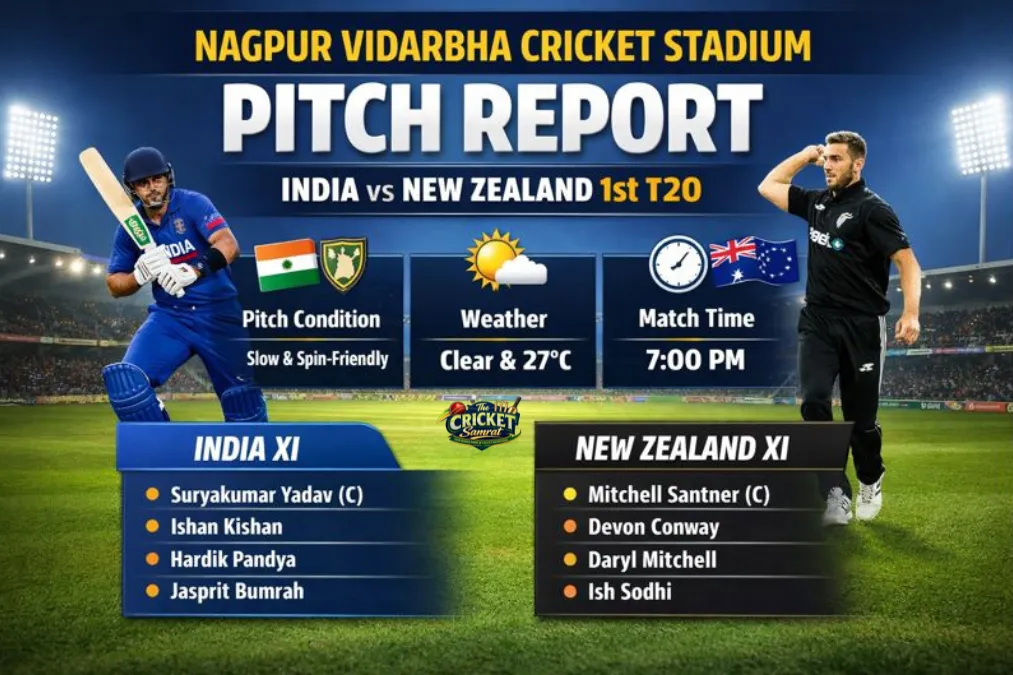
Nagpur Vidarbha Cricket Stadium Pitch Report: The Indian cricket team will face New Zealand in the first match of the five-match T20 series on Wednesday, January 21, at the Vidarbha Cricket Association (VCA) Stadium in Nagpur. The game is scheduled to begin at 7:00 PM IST, with the toss set for 6:30 PM IST. Fans are eagerly awaiting this exciting clash as both teams gear up for what promises to be a thrilling opening encounter.

Over the years, the VCA Stadium has hosted several T20 matches, but it has rarely witnessed extremely high scores. Historically, teams have found scoring big here challenging, making this venue a contest that favors bowlers, especially spinners.

In the past, India has played four T20 matches at Nagpur, winning two and losing two. This sets the stage for an intense battle between bat and ball as both teams look to kick off the series on a strong note.

Nagpur Vidarbha Cricket Stadium Pitch Report

The Nagpur vidarbha cricket stadium pitch report indicates that the game will be played on a slow, low-bounce pitch composed of dark soil. Here’s a detailed breakdown of pitch characteristics:

FeatureDetails
Pitch TypeBlack soil, slow
BattingModerate help; early batting possible but scoring difficult
BowlingAssists bowlers, particularly spinners
BounceLow; fast bowlers may not get extra carry
DegradationMinimal; will not break early, but may slow further by the second innings
AdvantageSlightly favors bowlers; spinners likely to dominate

The pitch at Nagpur generally provides assistance to spin bowlers due to its lower bounce. Fast bowlers may find it challenging to extract pace and carry, but disciplined line and length can still produce results. Key bowlers to watch include India’s Axar Patel and New Zealand captain Mitchell Santner, both of whom thrive in these conditions.

Weather Forecast in Nagpur for Match Day

Weather is a critical factor in T20 cricket, and the Nagpur vidarbha cricket stadium pitch report is incomplete without considering atmospheric conditions. According to AccuWeather, the forecast for match day is as follows:

Time of DayTemperature (°C)Conditions
Morning23°CSunny, clear skies
Afternoon27°CWarm, mild sun
Evening14°CCooling down, clear

No rain is expected, and the weather is likely to remain clear throughout the match. Considering these conditions, the team winning the toss may prefer to bat first, taking advantage of predictable pitch behavior in the early overs.

Probable Playing XI

Based on team announcements and recent performances, the probable line-ups for the first T20 between India and New Zealand are as follows:

India Probable XI

PlayerRole
Abhishek SharmaBatsman
Sanju SamsonWicketkeeper-batsman
Ishan KishanBatsman
Suryakumar Yadav (C)Batsman, Captain
Shivam DubeAll-rounder
Hardik PandyaAll-rounder
Rinku SinghBatsman
Axar Patel / Kuldeep YadavSpinner
Varun ChakravarthySpinner
Jasprit BumrahFast Bowler
Arshdeep SinghFast Bowler

New Zealand Probable XI

PlayerRole
Tim RobinsonBatsman
Devon ConwayBatsman
Rachin RavindraAll-rounder
Mark ChapmanBatsman
Daryl MitchellAll-rounder
Michael BracewellAll-rounder
James NeeshamAll-rounder
Mitchell Santner (C)Spinner, Captain
Ish SodhiSpinner
Matt HenryFast Bowler
Jacob DuffyFast Bowler

The battle between India’s experienced spinners and New Zealand’s dynamic all-rounders is expected to be decisive on this pitch.

Historical Context: India at Nagpur VCA Stadium

The Vidarbha Cricket Association Stadium has hosted numerous T20s, IPL matches, and other domestic fixtures. India’s track record here is mixed, with four T20 matches yielding two wins and two losses. Historically, high scores above 180 have been rare due to the pitch’s slow nature and low bounce, making it a bowler-friendly venue.

YearMatchResultHighest Team ScoreNotable Performer
2018India vs West Indies T20India won175/5Jasprit Bumrah 3/20
2019India vs Bangladesh T20India lost160/6Shakib Al Hasan 4/25
2021IPL: MI vs RCBMI won172/4Suryakumar Yadav 78*
2022IPL: DC vs CSKDC lost165/7Ravindra Jadeja 3/18

This historical insight emphasizes that matches at Nagpur often hinge on bowling strength and spin mastery, making toss-winning strategies crucial.

Toss and Match Strategy

Winning the toss at Nagpur can be a game-changer. Considering the slow pitch and pleasant weather, the team batting first often prefers to set a total and leverage the pitch’s gradual slowdown. Early wickets are vital as chasing becomes trickier in the second innings when the pitch starts to slow further.

Key Strategies for Teams

India:

  • Utilize spinners like Axar Patel and Varun Chakravarthy early.
  • Keep wickets in hand in the first 10 overs to accelerate later.
  • Fast bowlers to maintain disciplined lines to control run flow.

New Zealand:

  • Leverage Mitchell Santner and Ish Sodhi to contain batsmen.
  • All-rounders like Daryl Mitchell and Michael Bracewell can stabilize innings if early wickets fall.
  • Matt Henry and Jacob Duffy to focus on death overs containment.

Players to Watch

  • Suryakumar Yadav (India): Known for innovative strokeplay and ability to accelerate scoring in the middle overs.
  • Jasprit Bumrah (India): Can swing the game with early breakthroughs.
  • Mitchell Santner (NZ): Spin wizard, likely to exploit the low-bounce pitch.
  • Daryl Mitchell (NZ): Key all-rounder capable of anchoring the innings and contributing crucial wickets.

Also read: IND vs nz 1st T20 2026: India Begin World Cup Preparations With Crucial Opening Clash Against New Zealand in Nagpur

Expert Analysis

Cricket analysts suggest that this T20 encounter could favor the bowlers initially due to the nature of the Nagpur pitch. Spinners are likely to dominate, and teams may adopt a conservative start in the first six overs. With a clear weather forecast and no rain interruptions, the first innings total is expected to be moderate, probably in the 150–170 run range, making it a competitive chase for the team batting second.

The Nagpur vidarbha cricket stadium pitch report further notes that the pitch is unlikely to deteriorate drastically, meaning that batting in the second innings is feasible if teams handle spinners carefully. Captaincy decisions and field placements will play a pivotal role in determining the match outcome.

Also read: India versus New Zealand T20: Ishan Kishan Set for No. 3 Role as Suryakumar Yadav Reveals India’s Plans Ahead of Series Opener

Conclusion

The first T20 between India and New Zealand at the Vidarbha Cricket Association Stadium promises to be a thrilling contest, shaped heavily by spin-friendly conditions, disciplined bowling, and strategic batting. Fans can expect:

  • A competitive match with mid-range totals.
  • Critical contributions from spinners.
  • Key performances from all-rounders and death-over specialists.

With both teams boasting balanced squads and world-class players, the match outcome remains unpredictable, adding excitement to this highly anticipated T20 opener.

The Nagpur vidarbha cricket stadium pitch report, combined with the favorable weather forecast and strategic team composition, sets the stage for an exciting start to the T20 series.